How to Transform A sin θ + B cos θ Into a Single Trigonometric Function
In many physics, engineering, and mathematics problems, you’ll encounter expressions like A sin θ + B cos θ. Whether you’re solving differential equations, analyzing oscillations, or simplifying trigonometric identities, turning this sum into a single sinusoid can make the math much cleaner. The trick is to express it as a single sine (or cosine) function with a phase shift: R sin(θ + φ), where R is the amplitude and φ the phase angle. Below we walk through the derivation, show practical examples, and explain when this form is most useful.
Why Reduce A sin θ + B cos θ?
Combining the two terms eliminates the need to keep track of two separate coefficients during integration, differentiation, or comparison. For instance, the integral of a sine plus a cosine is straightforward once it’s rewritten as one sinusoid. Moreover, in signal processing, a single amplitude and phase representation allows for easier filtering and modulation.
The Classic Transformation
The identity you need is:
R sin(θ + φ) = A sin θ + B cos θ
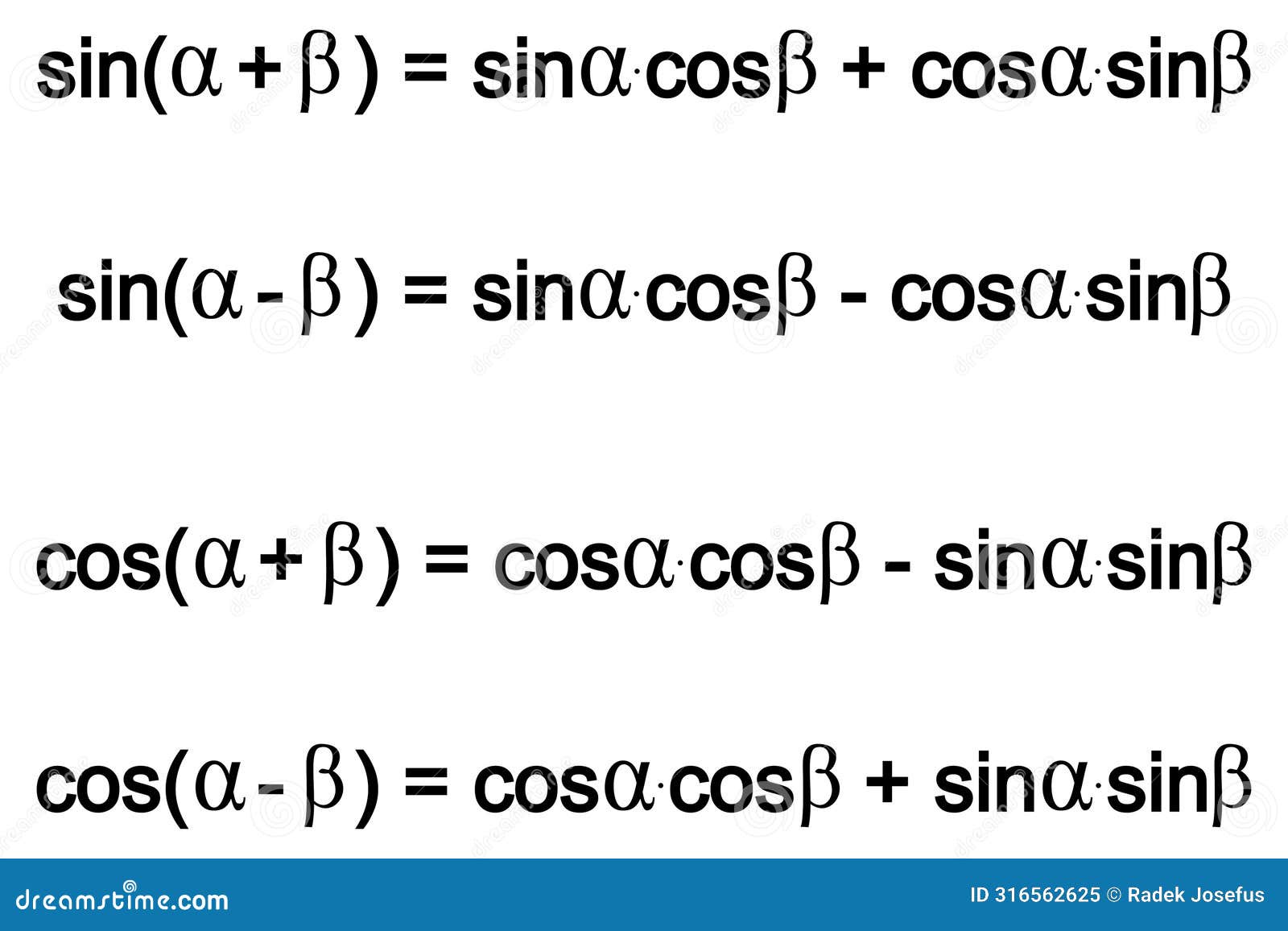
Here, R = √(A² + B²) and φ = arctan(B / A) (with care for the quadrant). The derivation follows from the sine addition formula:
- sin(θ + φ) = sin θ cos φ + cos θ sin φ
- Multiply by R: R sin θ cos φ + R cos θ sin φ
- Set coefficients equal to the original expression:
• R cos φ = A
• R sin φ = B
Divide the second equation by the first to find tan φ = B / A. Then R follows from the Pythagorean identity: R² = A² + B².
Step‑by‑Step Summary
- Compute R = √(A² + B²)
- Find φ = atan2(B, A) (use the two‑argument arctangent to preserve the correct quadrant)
- Rewrite as R sin(θ + φ) or, if preferred, R cos(θ – φ) with φ = arctan(A / B)
Worked Example
Let A = 3 and B = 4. First, R = √(3² + 4²) = 5. Next, φ = atan2(4, 3) ≈ 0.93 rad (53.13°). Therefore:
3 sin θ + 4 cos θ = 5 sin(θ + 0.93 rad)
Notice that 5 is the hypotenuse of a 3‑4‑5 right triangle, a familiar pattern that often surfaces in trigonometry.
Common Pitfalls
- Quadrant Errors: Using atan(B / A) instead of atan2 can flip φ to the wrong quadrant, leading to a sign error.
- Zero Coefficients: If one coefficient is zero, the phase simplifies to 0 or π/2, but the R formula still holds.
- Negative R: R is defined as the positive square root; any negative sign is absorbed into φ.
Practical Applications
1. Mechanical Vibrations: A mass-spring system driven by a force F = A sin θ + B cos θ can be represented by a single driving frequency, simplifying amplitude calculations.
2. Electrical Engineering: Alternating current circuits often involve voltage components at the same frequency but different phases; combining them into one sinusoid aids in phasor analysis.
3. Signal Modulation: In communications, adding two carriers with phase offsets reduces to a single carrier with a net phase, simplifying demodulation.
FAQ
Q1: Can I always use R sin(θ + φ) for any A and B?
A1: Yes, as long as A and B are real numbers. The formula holds universally.
Q2: What if I want the result in cosine form?
A2: Use the identity sin(x) = cos(x – π/2). Then R cos(θ – φ + π/2) is equivalent.
Q3: How does this relate to the amplitude-phase form of complex numbers?
A3: The vector (A, B) in the plane corresponds to the complex number A + iB. Its magnitude R and argument φ are exactly the amplitude and phase of the combined sinusoid.
Mastering the A sin θ + B cos θ conversion unlocks a smoother path through many trigonometric challenges, whether you’re dealing with textbook problems or real‑world engineering equations.