How to Find Endpoints Using the Midpoint Formula: Step‑by‑Step Examples
Endpoint From Midpoint Formula & Examples Explained: In many geometry and algebra problems, you’re given the midpoint of a line segment and must recover its endpoints. This guide breaks the process into clear steps, with examples to cement your understanding.
Endpoint From Midpoint Formula & Examples Explained
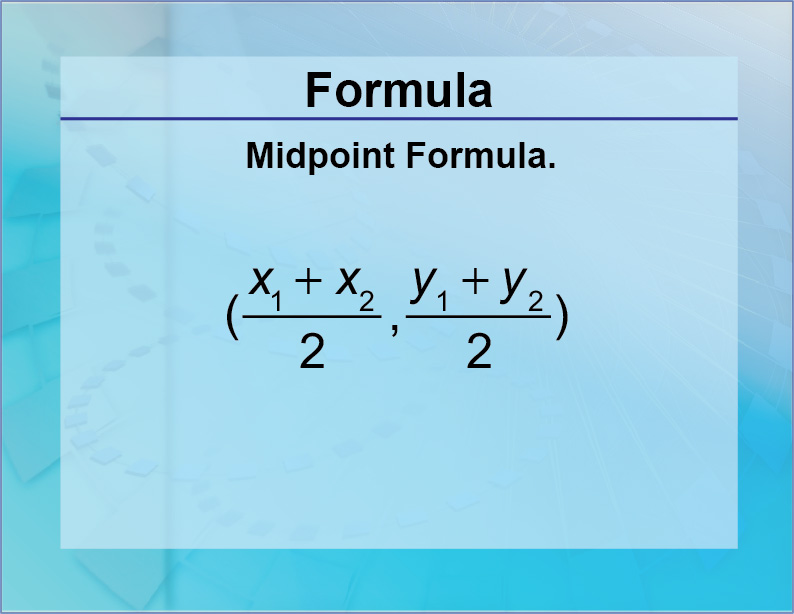
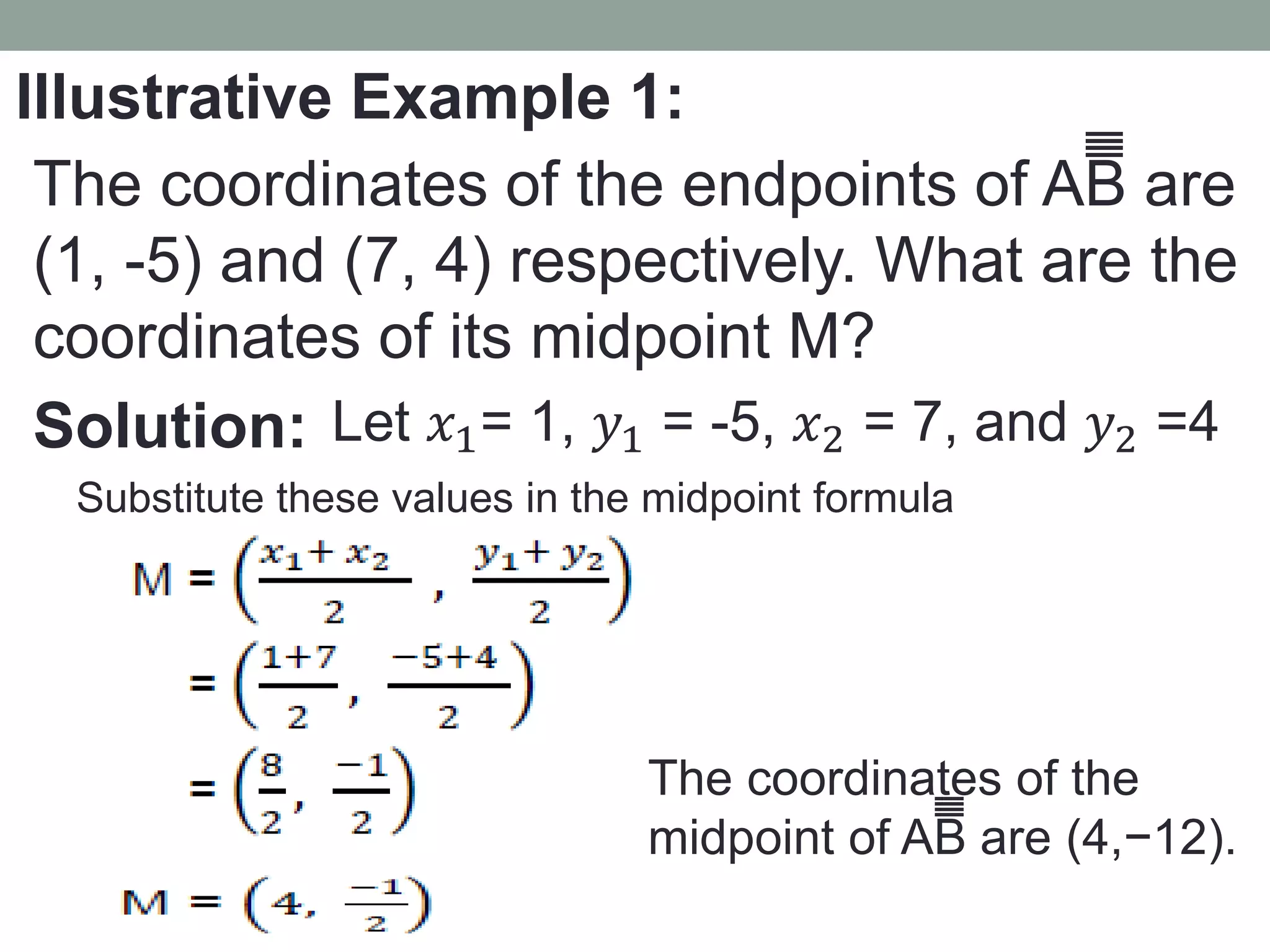
The classic midpoint formula is a quick way to locate the middle of a segment when you know both endpoints: if A = (x₁, y₁) and B = (x₂, y₂), then the midpoint M is ((x₁ + x₂)/2, (y₁ + y₂)/2). When the reverse is needed—given M and one endpoint, find the missing endpoint—the algebra simply reverses those averages.
Reversing the Process: The Core Idea
Suppose you know M = (mₓ, m_y) and you’re given point A = (x₁, y₁). To find B = (x₂, y₂), set up two equations:
- mₓ = (x₁ + x₂)/2 → x₂ = 2mₓ – x₁
- m_y = (y₁ + y₂)/2 → y₂ = 2m_y – y₁
These simple rearrangements give you B directly. The same logic applies in one dimension (just x‑coordinates) or in higher dimensions by treating each coordinate separately.
Example 1: Two‑Dimensional Coordinates
Let the midpoint be M = (4, 5) and one endpoint be A = (2, 1). Apply the formulas:
- x₂ = 2·4 – 2 = 6
- y₂ = 2·5 – 1 = 9
Thus B is (6, 9). Checking, the average of (2, 1) and (6, 9) is indeed (4, 5).
Example 2: One‑Dimensional Case
When only a single coordinate is involved—say the midpoint of a line on the number line is 7 and one endpoint is 3—solve 7 = (3 + x)/2. Multiply by two: 14 = 3 + x → x = 11. So the other endpoint is 11.
Example 3: Three‑Dimensional Coordinates
Given M = (1, –2, 4) and A = (3, 0, –1), find B:
- x₂ = 2·1 – 3 = –1
- y₂ = 2·(–2) – 0 = –4
- z₂ = 2·4 – (–1) = 9
So B is (–1, –4, 9). Plugging back into the midpoint formula confirms the result.
When Only the Midpoint Is Known
If no endpoint is provided, the problem is underdetermined: infinitely many segments share the same midpoint. In that case, you need at least one more piece of information—such as a point, a slope, or a length—to pin down a unique pair of endpoints.
Common Mistakes to Avoid
- Forgetting to double the midpoint coordinate before subtracting the known endpoint.
- Mixing up the order of subtraction (2m – x₁ vs. 2m + x₁).
- Assuming a single solution exists without an additional constraint.