Understanding Muffle Furnace Specs: A Complete Buying Guide
When a lab needs to heat samples to high temperatures, the muffle furnace is often the go‑to device. But buying one isn’t as simple as picking the cheapest option off the shelf. The performance of a furnace hinges on its specifications—temperature range, heating rate, accuracy, and more. This guide breaks down the most critical muffle furnace specs, explains why they matter, and shows how to choose the right unit for your experiments.
Muffle Furnace Specs Explained
Temperature Range
The maximum temperature a furnace can reach determines its suitability for a given task. Most low‑ to medium‑temperature models max out at 900 °C, while high‑temperature units can hit 1200–1500 °C or more. If your work involves ceramics or metal alloy treatments, you’ll need a furnace that reaches the necessary peak temperature.
Heating Rate
Heating rate—usually expressed in °C/min—affects how quickly a sample can reach its target temperature. Fast rates (20–30 °C/min) save time but may create temperature gradients, whereas slower rates (5–10 °C/min) give more uniform heating.
Temperature Accuracy & Uniformity
Accuracy tells how close the furnace’s displayed temperature is to the actual temperature. A ±2 °C tolerance is common for most applications. Uniformity measures temperature variation across the chamber; a uniformity of <2 °C across a 30 mm diameter is typical for analytical-grade furnaces. Uniformity is critical when sample size is small or when precise thermal history matters.
Chamber Size & Shape
Internal volume, height, and diameter dictate how many samples you can process at once. Typical dimensions range from 10 × 15 cm for bench‑top units to 30 × 35 cm for industrial models. The shape—rectangular versus cylindrical—affects heat distribution and sample accessibility.
Insulation & Energy Efficiency
High‑quality insulation (ceramic fiber or mineral wool) reduces heat loss, allowing faster ramp times and lower power consumption. Look for furnaces that offer programmable power‑saving modes; some units consume 20–30 % less energy than older models.
Power Supply & Control System
Typical industrial furnaces run on 230 V or 400 V AC. Modern units often feature touch‑screen panels with PID control, programmable cycles, and data logging. A robust control system can reduce temperature overshoot and improve reproducibility.
Safety Features
Key safety components include over‑temperature protection, door interlocks, automatic shut‑off, and fire‑resistant construction. For laboratories with hazardous samples, consider furnaces with built‑in safety alarms and remote monitoring capabilities.
Types of Muffle Furnaces & Their Common Specs
- Low‑Temperature (<900 °C) – Ideal for glass, polymer, and low‑melting‑point materials. Specs: 500–900 °C, 5–12 °C/min, ±3 °C accuracy.
- Medium‑Temperature (900–1200 °C) – Used for ceramics, metallurgy, and basic research. Specs: 1000–1200 °C, 10–20 °C/min, ±2 °C accuracy, 25–30 mm uniformity.
- High‑Temperature (1200–1500 °C+) – For advanced metallurgy, semiconductor processing, and high‑temperature chemistry. Specs: 1200–1500 °C, 15–25 °C/min, ±1 °C accuracy, <1 °C uniformity.
How to Interpret Technical Datasheets
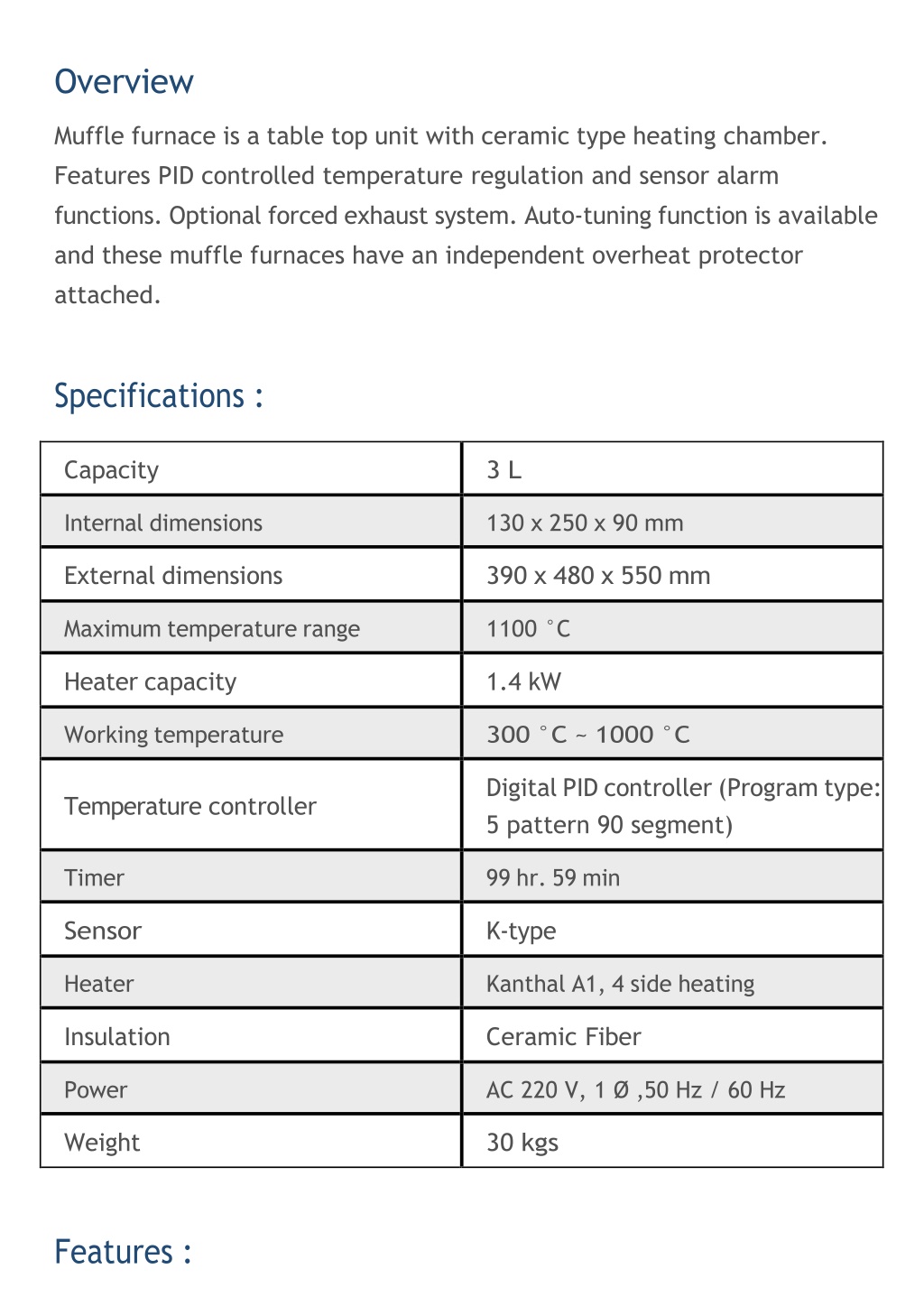
Technical datasheets can be dense, but a few key sections help you compare models quickly:
- Maximum Temperature – Check both rated and absolute limits.
- Temperature Stability – Look for a ± tolerance and the conditions under which it applies.
- Ramping Rates – Note whether they’re constant or vary with temperature.
- Chamber Dimensions – Measure internal volume and verify it accommodates your sample holders.
- Electrical Draw – Important for planning lab power requirements and estimating operating cost.
Choosing the Right Furnace for Your Lab
Align your choice with these practical considerations:
- Application – Ceramics, metal alloying, polymer curing, or analytical chemistry each demand different temperature regimes.
- Sample Volume – Small vials need tight temperature control; bulk samples benefit from larger chambers.
- Cycle Time – Fast ramps save hours but may require higher power.
- Budget & Energy Costs – Higher‑end models offer better uniformity but come at a premium.
- Future Growth – Consider expandable systems or modular accessories if you anticipate scaling up.
Maintenance and Calibration: Keeping Specs Accurate
A furnace’s specifications are only meaningful if the unit performs as advertised. Routine maintenance includes:
- Cleaning the chamber and heating elements every 6–12 months to prevent contamination.
- Checking the temperature sensor (thermocouple) monthly and replacing it if drift exceeds ±1 °C.
- Verifying the PID controller’s setpoint accuracy with a calibrated reference thermocouple before critical runs.
- Inspecting door seals and interlocks annually to ensure safety features remain operational.
Common Mistakes in Selecting Spec
Even seasoned technicians sometimes overlook:
- Uniformity vs. Accuracy – A furnace that reads 1200 °C might actually vary by 5 °C across the chamber, leading to inconsistent results.
- Ignoring Power Supply Compatibility – Some high‑temperature units require a