The Ultimate Guide to LM7805 Specs and How They Work
When you pull out a 7805 regulator from a junk drawer, the first thing that catches your eye is the little line of numbers stamped on its side. Those numbers hide a whole set of specifications that determine whether the chip will keep your circuit humming at a steady 5 V or fry it on the spot. In this guide we’ll unpack the most important LM7805 specs, explain what they mean in plain English, and show you how to match them to real‑world projects.
What Is an LM7805 Regulator?
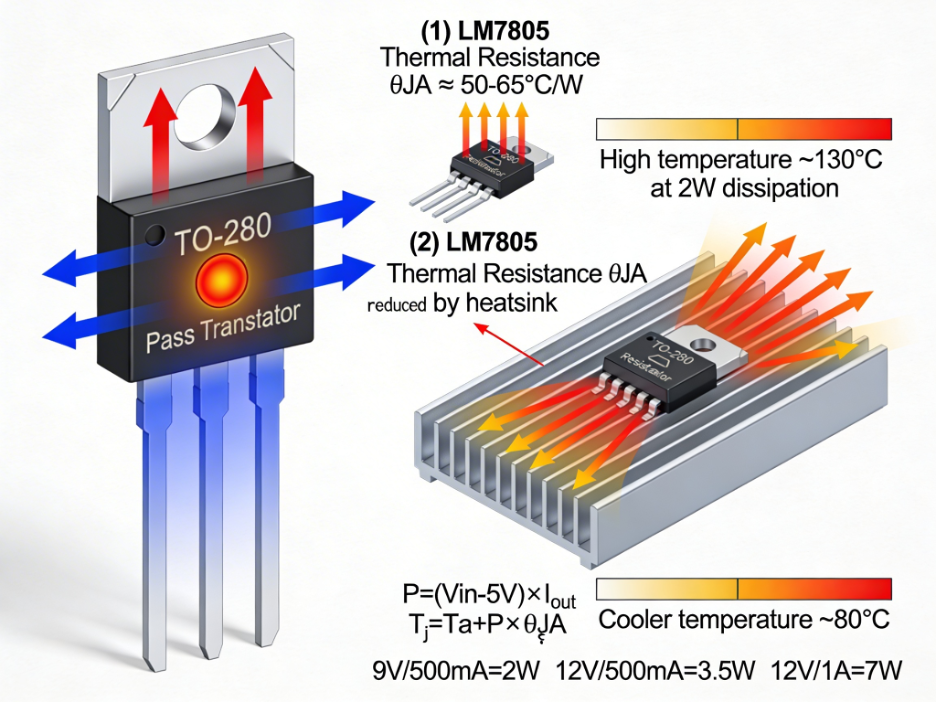
The LM7805 belongs to the classic 78xx family of three‑terminal linear voltage regulators. It takes a higher, unregulated input voltage and delivers a regulated 5 V output, all while requiring just two external capacitors for stability. Because it’s a linear device, the excess voltage is turned into heat, which makes thermal considerations a key part of the spec sheet.
Despite being introduced in the 1970s, the LM7805 remains popular in hobbyist kits, Arduino shields, and even some industrial power supplies thanks to its low cost and ease of use.
Key Electrical Specifications
Below are the specs you’ll see on most datasheets. They’re the yardsticks that tell you if the regulator fits your design constraints.
- Output Voltage: Fixed at 5.00 V ±2 % at 25 °C; tolerance widens to ±5 % over the full line and temperature range.
- Maximum Input Voltage: 35 V (absolute maximum 40 V, but stay well below that to avoid breakdown).
- Drop‑out Voltage: Typically 2 V for the standard LM7805; low‑dropout versions can get down to ~1.1 V.
- Output Current: Up to 1.5 A continuous, provided the package can dissipate the resulting heat.
- Quiescent (Ground) Current: 5–6 mA typical, rising slightly as the input‑output differential grows.
- Thermal Resistance (θJA): About 50 °C/W for a TO‑220 package without a heatsink; add a heatsink to keep junction temperature below 125 °C.
- Power Dissipation: P = (Vin – 5 V) × Iout. Without a heatsink, stay under ~2 W for reliable operation.
- Pinout: Looking at the flat side, pins are Input, Ground, Output (left to right).
Typical Applications and Why Specs Matter
Because the LM7805 delivers a clean 5 V, it’s a go‑to solution for powering microcontrollers, sensors, and digital logic that demand a stable supply. However, the spec sheet tells you where the regulator shines and where it struggles.
For instance, if you feed a 12 V battery into an LM7805 delivering 500 mA, the device will dissipate (12 – 5) × 0.5 = 3.5 W. That exceeds the safe dissipation for a bare TO‑220, so you’d need a heatsink or consider a switching regulator instead.
Another common pitfall is ignoring the dropout voltage. If your source is a 6 V wall adapter, the regulator might never reach a full 5 V output because it needs at least 7 V at the input. In such low‑headroom scenarios a low‑dropout (LDO) variant is the smarter choice.
How to Choose the Right LM7805 for Your Project
Start by mapping your input voltage range to the maximum allowable input (35 V). If your source swings close to that ceiling, you might need a regulator with a higher voltage rating or add a pre‑regulation stage.
Next, calculate expected power dissipation using the formula above. If the result tops 2 W, plan for a heatsink or pick a package with better thermal performance, such as the TO‑263 (D²PAK).
Finally, look at the quiescent current spec if your design is battery‑powered. A few milliamps of idle draw can drain a small cell quickly, so an LDO with lower ground current may extend runtime.
Common Pitfalls and Troubleshooting
Overheating: When the regulator feels hot to the touch, check your input‑output voltage difference and add a heatsink or reduce load current.
Voltage Ripple: Insufficient input or output bypass capacitors can cause oscillations. A 0.33 µF ceramic on the input and a 0.1 µF plus 10 µF electrolytic on the output usually solve the problem.
Incorrect Pin Wiring: The LM7805’s pins are often misidentified, especially in kits where the regulator is mounted backward. Double‑check the datasheet before soldering.
Exceeding Current Limits: If you see the output voltage droop under load, you may be pushing beyond the 1.5 A limit. Either share the load across multiple regulators or move to a switching regulator.
FAQ
Q: Can I use an LM7805 with a 9 V battery?
A: Yes, but expect about (9 – 5) × Iout watts of heat. For modest currents (under 200 mA) the regulator can run without a heatsink, though efficiency will be low.
Q: What happens if the input voltage exceeds 35 V?
A: The device can enter a latch‑up condition, potentially damaging the regulator and downstream circuitry. Use a voltage‑clamping diode or a higher‑rated regulator in such cases.
Q: Do I really need both input and output capacitors?
A: While the regulator can operate without them, the datasheet recommends them to ensure stability and reduce output noise, especially when the load varies quickly.
Q: Is the LM7805 suitable for high‑frequency applications?
A: Linear regulators like the LM7805 have limited bandwidth and are best for low‑frequency or DC supplies. For fast‑switching or RF circuits, a dedicated low‑noise LDO or switching regulator is preferable.