The Top Five Longest English Words You’ll Never Guess
Language is a playground for the curious, and when you stumble across words that stretch the limits of our alphabet, the intrigue is almost instant. Whether you’re a linguist, a student, or just someone who loves a good challenge, the longest words in the English language offer a fascinating peek into how English borrows, blends, and invents. Below we’ll explore five of the most impressive entries, from medical jargon to pop‑culture gems, and discover why they stick in our heads.
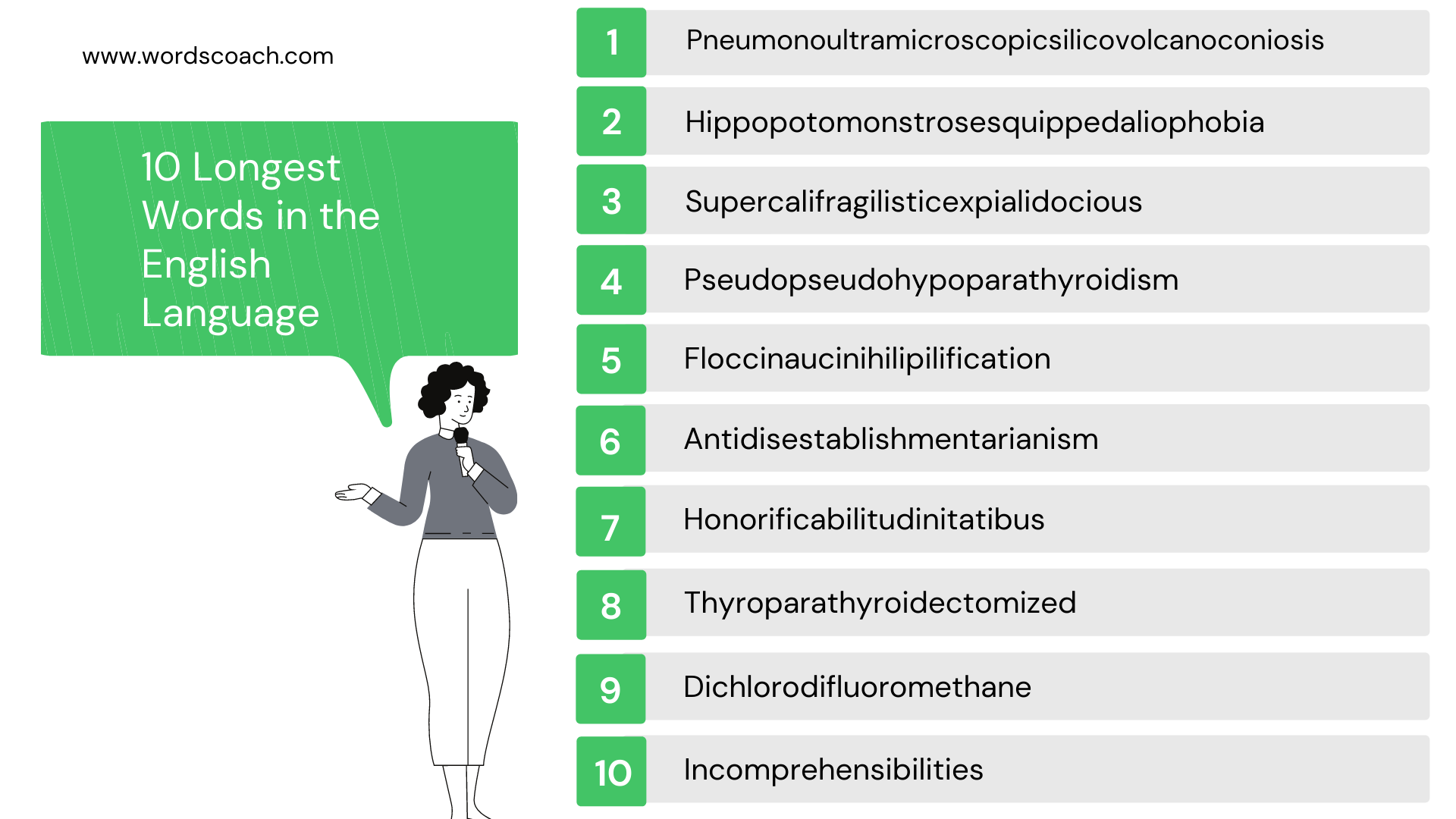
1. Pneumonoultramicroscopicsilicovolcanoconiosis
This 45‑letter word is the crown jewel of long English words. It refers to a lung disease caused by inhaling fine volcanic ash or silica dust—essentially, an occupational hazard for miners and construction workers. The term was coined in the 1930s by the National Puzzlers' League as a playful but technically accurate description of the condition. Because it packs a precise medical meaning into a single, elongated string, it’s both a linguistic curiosity and a reminder of how science can drive vocabulary.
Pronounced puh-muh-noh-oo-truh-mik-ROH-skop-ik-si-lo-vo-kah-nuh-CON-ee-oss-iss, the word’s construction is a mash‑up of Greek and Latin roots: pneumon (lung), ultra (beyond), micro (small), scopic (viewing), silico (silicon), volcano (volcano), and coniosis (dust-related disease). Its length, however, is less about elegance than about capturing the full complexity of a rare disease in one bite‑size package.
2. Hippopotomonstrosesquipedaliophobia
Ironically, this 36‑letter word means the fear of long words. The term blends hippopotamus (to suggest something huge), monstrous (extraordinary), sesqui (one and a half), pedali (foot), and phobia (fear). It was popularized in the 1980s as a humorous take on word‑loving, and it has since found a home in dictionaries and joke books alike.
Because its meaning is self‑referential, the word is often used in tongue‑in‑cheek contexts. For example, a language teacher might quip, “I can’t stand a test with hippopotomonstrosesquipedaliophobia in the questions.” Its playful construction showcases how English can layer meanings and create a self‑parodying term that’s both long and fun.
3. Supercalifragilisticexpialidocious
Perhaps the most famous of the bunch, this 34‑letter word made its debut in the 1964 Disney film *Mary Poppins*. The song “Supercalifragilisticexpialidocious” turns the word into a joyful exclamation: “When you’re feeling… you say it!” Though it’s more of a playful invention than a technical term, the word’s endurance proves that a clever blend of nonsense can become a cultural staple.
The construction is essentially a collage of nonsensical syllables meant to evoke wonder: super‑ (above), cali‑fragilistic (fragile), expialidocious (exciting). Its popularity illustrates how pop culture can elevate a contrived word to everyday usage—something that happens rarely in the otherwise serious world of English lexicon.
4. Floccinaucinihilipilification
At 29 letters, this noun describes the act of regarding something as unimportant or worthless. It’s derived from a Latin chain: flocci‑ (of a small cloth), nauci‑ (small), nihili‑ (nothing), pili‑ (like a hair), combined with the Latin suffix -fication. The word surfaced in the 19th century and found its way into the Oxford English Dictionary as a playful but precise way to talk about devaluation.
Despite its technical feel, floccinaucinihilipilification is rarely used in everyday speech. Instead, it’s most often cited by word enthusiasts and trivia buffs as a prime example of a long, yet legitimate, English term. Its inclusion in dictionaries underscores that length doesn’t preclude legitimacy—if the term fills a semantic gap, it earns its place.
5. Antidisestablishmentarianism
At 28 letters, this political term refers to the movement that opposed the disestablishment of the Church of England in the 19th century. The word’s roots combine anti‑ (against), dis‑ (removal), establishment (institution), and ‑arianism (belief). Though it’s a mouthful, it succinctly captures a complex historical debate about church and state.
Today, antidisestablishmentarianism is more often quoted as a linguistic oddity than as a political stance. It remains a popular example of a “political buzzword” that has survived the test of time, showing that even complex concepts can be packed into a single, elongated string.
Why Knowing Long Words Matters
Long words may seem like trivia, but they play a real role in language. They:
- Fill lexical gaps where no shorter term exists.