Mastering Lagrange Multipliers: A Simple Guide to Constraint Optimization
Lagrange multipliers can feel like a secret code that only advanced math students crack. Yet the core idea is surprisingly straightforward: it lets you find the maximum or minimum of a function while respecting one or more constraints. In this article we break down the method into bite‑sized chunks, show you how to set it up, and walk through a concrete example that brings the theory to life.
What Are Lagrange Multipliers?
Imagine you want to push a block to the edge of a table while keeping it on a tilted surface. The table’s slope is your constraint, and you’re looking for the point where the block’s potential energy is lowest. Lagrange multipliers give you a systematic way to impose that constraint while still hunting for the optimum. Instead of juggling inequalities and corner cases, you add a new variable—called the multiplier—to your equations. That variable acts like a weight, telling you how much the constraint influences the objective.
Step‑by‑Step: Setting Up the System
1. Define the objective function \(f(x, y, \dots)\) you want to optimize.
2. Write each constraint as an equation \(g_i(x, y, \dots)=0\). If a constraint is an inequality, you can transform it into an equality by introducing slack variables.
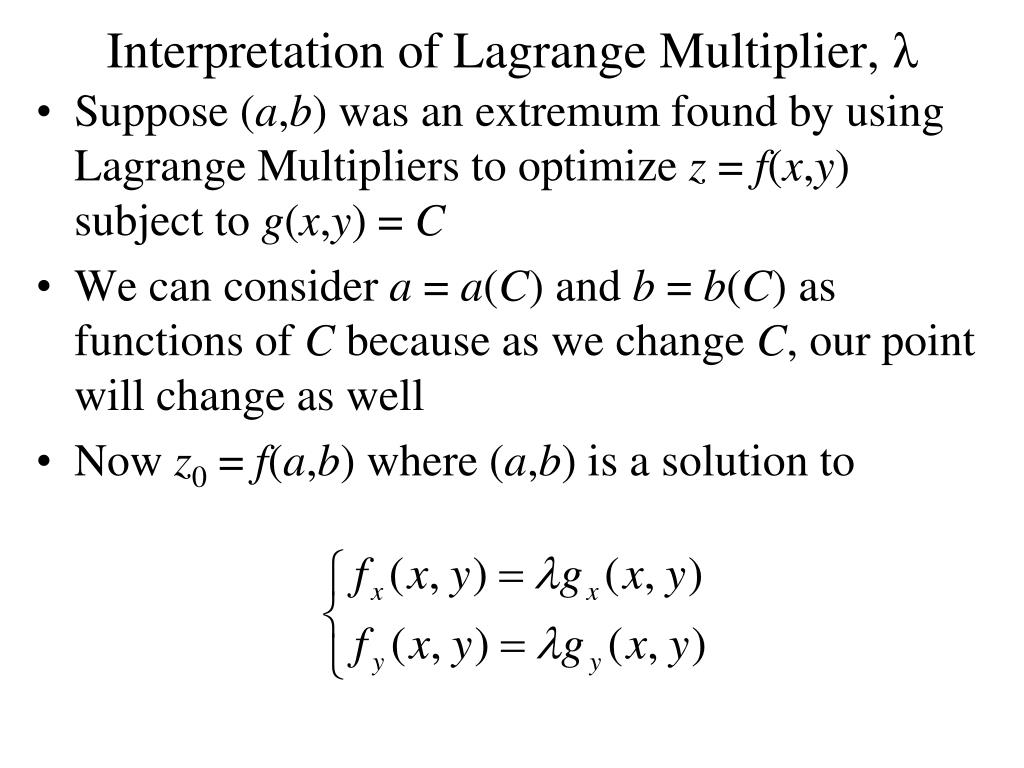
3. Form the Lagrangian: \(\mathcal{L}=f + \lambda_1 g_1 + \lambda_2 g_2 + \dots\). Each \(\lambda_i\) is a new unknown.
4. Take partial derivatives of \(\mathcal{L}\) with respect to every original variable and every multiplier, then set each derivative equal to zero. You now have a system of equations.
5. Solve the system. The solutions give candidate points. Plug them back into the original function and constraints to pick the best one.
Why This Works
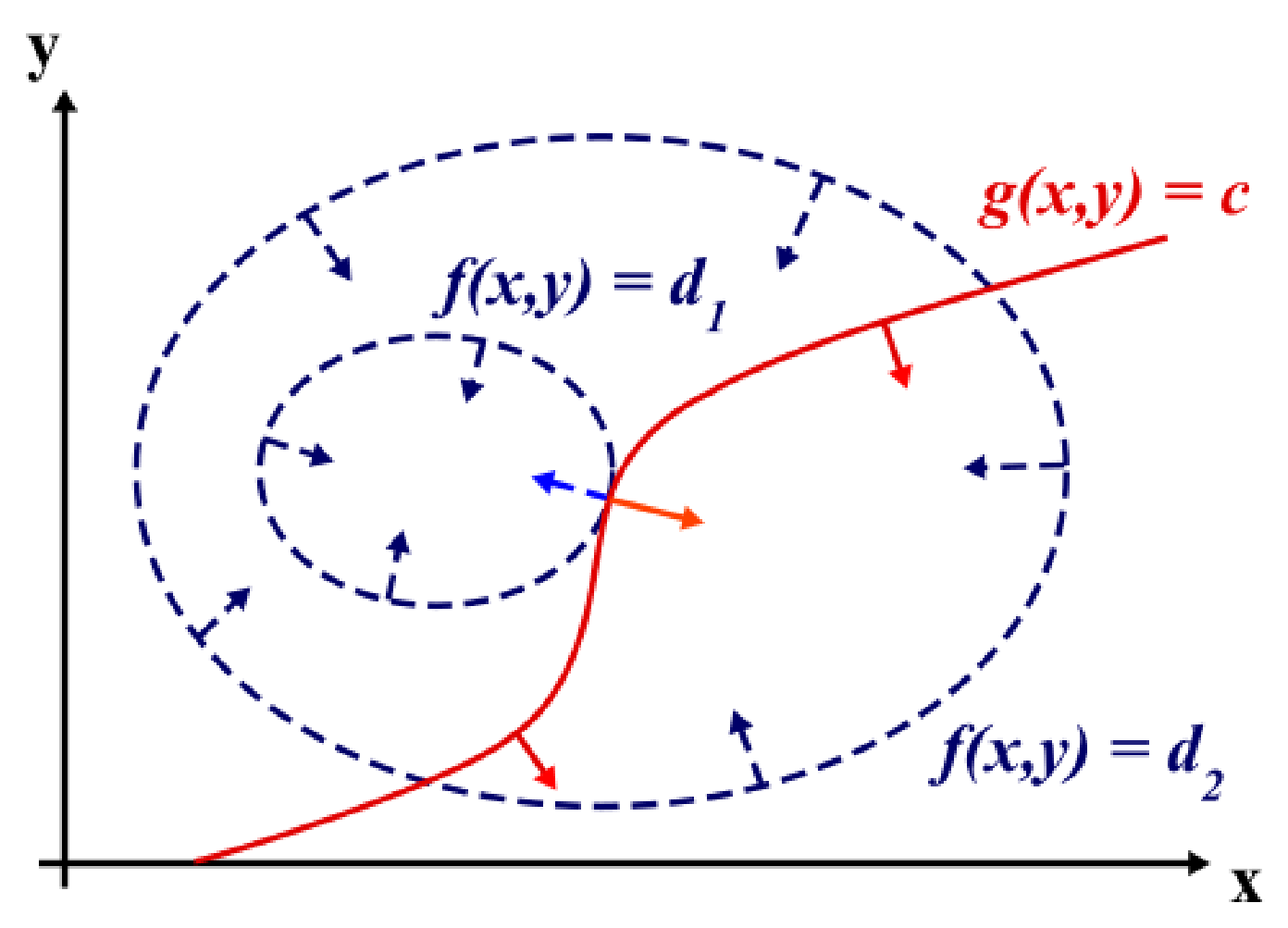
Mathematically, the method arises from the fact that at an optimum the gradients of the objective function and of every constraint are parallel. The multiplier \(\lambda\) scales the constraint’s gradient to match that of the objective. In other words, the direction in which you can still move without violating the constraint is orthogonal to the gradients; if you’re truly at a peak or trough, you can’t improve by moving in that direction.
Concrete Example: Optimizing a Simple Surface
Suppose you want to find the point on the curve \(x^2 + y^2 = 1\) that maximizes the height function \(f(x, y) = 3x + 4y\). The curve is a circle, and the height is a linear combination of \(x\) and \(y\). We’ll walk through the steps.
- Objective: \(f(x, y) = 3x + 4y\)
- Constraint: \(g(x, y) = x^2 + y^2 - 1 = 0\)
Build the Lagrangian: \(\mathcal{L} = 3x + 4y + \lambda (x^2 + y^2 - 1)\).
Take partials:
- \(\frac{\partial \mathcal{L}}{\partial x} = 3 + 2\lambda x = 0\)
- \(\frac{\partial \mathcal{L}}{\partial y} = 4 + 2\lambda y = 0\)
- \(\frac{\partial \mathcal{L}}{\partial \lambda} = x^2 + y^2 - 1 = 0\)
From the first two equations, solve for \(x\) and \(y\) in terms of \(\lambda\):
- \(x = -\frac{3}{2\lambda}\)
- \(y = -\frac{4}{2\lambda} = -\frac{2}{\lambda}\)
Insert these into the constraint:
- \(\left(-\frac{3}{2\lambda}\right)^2 + \left(-\frac{2}{\lambda}\right)^2 = 1\)
- \(\frac{9}{4\lambda^2} + \frac{4}{\lambda^2} = 1\)
- \(\frac{25}{4\lambda^2} = 1 \;\Rightarrow\; \lambda^2 = \frac{25}{4} \;\Rightarrow\; \lambda = \pm \frac{5}{2}\)
Choosing \(\lambda = \frac{5}{2}\) gives:
- \(x = -\frac{3}{5}\)
- \(y = -\frac{4}{5}\)
The other root, \(\lambda = -\frac{5}{2}\), flips the signs, yielding the opposite point. Plugging the positive‑sign solution back into \(f\) gives the maximum: \(f = 3(-\frac{3}{5}) + 4(-\frac{4}{5}) = -\frac{21}{5}\). The negative‑sign solution gives the minimum.
Notice how the method turned a geometric problem into a handful of algebraic equations—no guessing or trial‑and‑error needed.
When to Use Lagrange Multipliers
• Optimizing in physics – finding the equilibrium configuration of a system subject to conservation laws.
• Engineering design – maximizing efficiency while keeping materials within stress limits.
• Economics – allocating resources to maximize profit while respecting budget constraints.
• Statistics – estimating parameters that maximize likelihood under normalizing constraints.
In short, any time you have an objective that depends on several variables and you must stay on a prescribed surface or curve, Lagrange multipliers are a powerful tool.
Common Pitfalls & How to Avoid Them
Confusing constraints for inequalities: The basic method assumes equalities. For strict inequalities, look to the Karush–Kuhn–Tucker (KKT) conditions or introduce slack variables.
Forgetting to check boundary points: Lagrange multipliers only find interior stationary points. If the feasible set has a boundary where the objective peaks, you must evaluate those points separately.
Overlooking multiple solutions: The system can produce several candidates. Test each by substituting back into the original functions.
Misinterpreting the multiplier sign: A positive \(\lambda\) indicates the constraint pushes the objective upward; a negative \(\lambda\) indicates it pulls downward. The magnitude tells how strongly the constraint influences the optimum.
FAQs About Lagrange Multipliers
- Can I use Lagrange multipliers with non‑smooth functions? No. The method relies on differentiability. For non‑smooth cases, consider subgradient methods or alternative optimization techniques.
- What if there