How ESC Keeps You on the Road: A Practical Guide to Electronic Stability Control
When a driver swerves, slips or suddenly brakes, the vehicle’s fate hinges on a single, often unseen, system: Electronic Stability Control, or ESC. First introduced in the early 2000s, ESC has become a standard safety feature in most cars today, quietly preventing skids and keeping steering power where it belongs.
What is Electronic Stability Control?
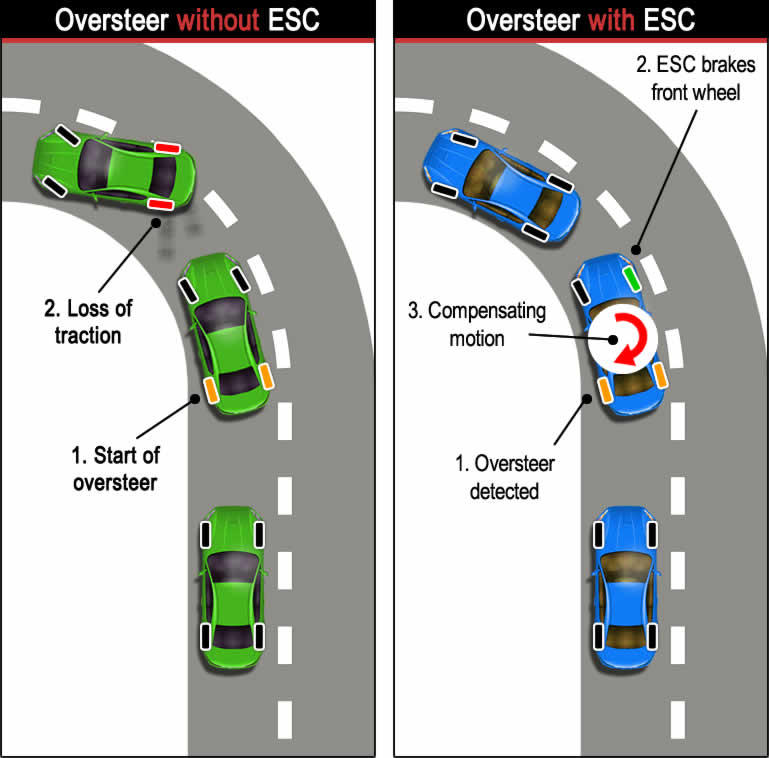
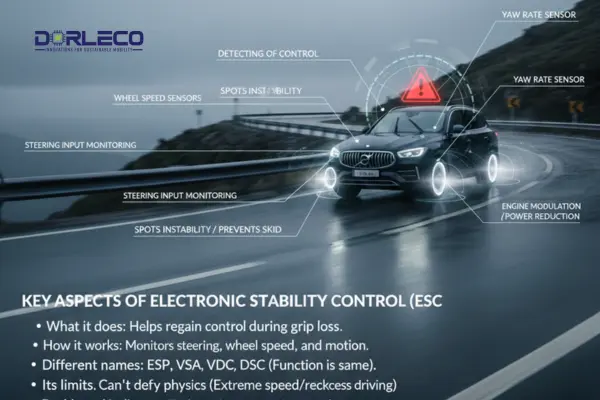
ESC is a computerized system that monitors steering angle, wheel speed and lateral acceleration. If it detects that the car is veering away from the intended path—whether due to sudden steering input or uneven road surface—it can selectively apply brake force to individual wheels and, in some models, reduce engine torque. The result is a subtle correction that restores the vehicle’s trajectory without the driver realizing a separate intervention occurred.
How ESC Works Behind the Scenes
At the core of ESC are three essential sensors:
- Yaw rate sensor – measures the vehicle’s rotation around its vertical axis.
- Steering angle sensor – tells how far the wheel is turned.
- Wheel speed sensors – detect slippage on each wheel.
When the system flags a mismatch—such as the car turning less than the steering input would suggest—ESC commands the brake on the outer wheel and/or throttles the engine to counteract the drift. In high‑performance models, this process occurs in milliseconds, offering a seamless safety net.
Key Benefits of ESC for Everyday Drivers
Beyond the obvious safety gains, ESC delivers practical advantages:
- Improved Control – Helps maintain directional stability during emergency maneuvers.
- Reduced Accident Risk – Studies consistently show a 15‑20 % drop in rollovers and T‑wheels in vehicles equipped with ESC.
- Enhanced Confidence – Drivers feel more secure when they know the car will correct itself on slippery or uneven surfaces.
- Insurance Incentives – Many insurers offer discounts for vehicles with ESC, reflecting its proven safety record.
ESC vs. Traction Control: The Difference Matters
While both systems share a goal of preventing wheel slip, their focus diverges:
- Traction Control (TC) – Works to keep each wheel spinning at the same rate during acceleration. If the front wheel loses grip, TC will reduce throttle or apply brake to that wheel.
- Electronic Stability Control (ESC) – Focuses on maintaining the vehicle’s path, adjusting brakes or engine torque during cornering or sudden steering inputs.
Modern cars often bundle TC as part of the ESC package, so when you see a single ESC icon on the dashboard, it usually encompasses both functions.
How to Test If Your ESC Is Working
While you cannot feel ESC directly, you can observe its presence through a few simple checks:
- Dashboard Indicator – A square‑shaped symbol with a car inside (usually labeled “ESC” or “ESP”) should illuminate briefly when the engine starts and then turn off.
- Road Test – On a dry, straight stretch, step on the accelerator while turning left or right. The car should stay on course without excessive wheel spin. On a wet or gravel surface, the vehicle should not slide outward during a sharp turn.
- Brake Check – Apply brakes while steering. If the car behaves predictably and doesn’t skid, ESC is likely engaged.
Professional diagnostic tools can read ESC fault codes if you suspect a malfunction.
When ESC Might Not Engage
There are circumstances where ESC will deliberately remain silent:
- Extreme Slip – If the vehicle is already in a severe loss‑of‑control situation, ESC may not correct the trajectory.
- System Faults – A sensor failure, low battery, or software glitch can disable ESC, often accompanied by a warning light.
- Low-Speed Driving – ESC typically activates above a threshold speed; at very low speeds it is unnecessary.
Regular maintenance checks and keeping sensors clean can minimize unintended deactivation.
Future Trends in ESC Technology
As automotive technology evolves, ESC is becoming smarter:
- Adaptive ESC – Adjusts thresholds based on tire condition, road type, and driving style.
- Integration with Driver Assistance Systems – Works in concert with lane‑keeping, adaptive cruise control and autonomous driving modules.
- Predictive Algorithms – Use camera and radar data to anticipate potential loss of control moments before they happen.
These advancements promise even greater safety margins, especially as vehicles transition toward full automation.
Frequently Asked Questions
Q: Is ESC mandatory on new cars?
A: In the United States, the NHTSA mandated ESC for all passenger vehicles sold after 2012. Many other countries have similar regulations, making ESC a near‑universal feature on modern cars.
Q: Can I disable ESC if I’m a racing driver?
A: Some manufacturers allow disabling ESC via a dashboard switch or a diagnostic port. However, doing so reduces safety and may violate local regulations for street‑legal vehicles.
Q: What happens if the ESC warning light stays on?
A: A persistent warning indicates a fault. It’s advisable to have the vehicle inspected by a qualified technician, as ESC failure can increase accident risk.